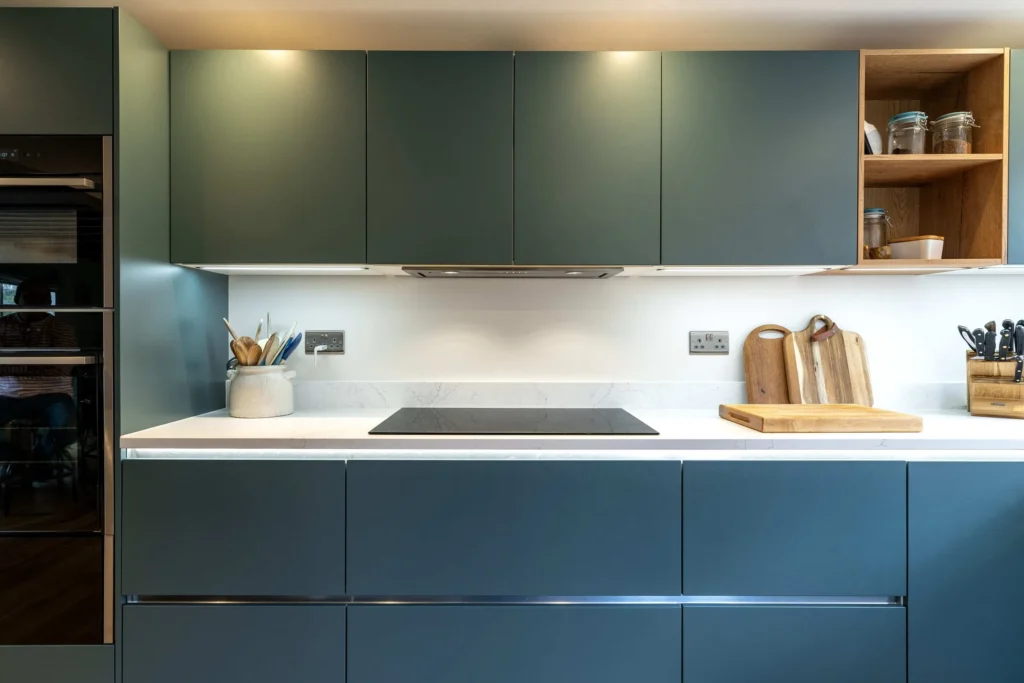
A crowded kitchen makes daily cooking feel heavy. Visible handles break the clean lines of your space and draw attention to the wrong places. When you want a calm and simple home, every small detail matters. Handleless kitchen cabinets solve this problem by removing visual noise and giving the room a smoother flow.
We provide full-house building materials supported by factory manufacturing in Foshan. Our service covers kitchens, wardrobes, bathrooms, windows, tiles, lights, flooring, and wall panels. We work with homeowners, renovators, builders, designers, and developers who want one-stop solutions. We can support full interior design, exterior modeling, 3D layouts, container loading plans, and export logistics. Our goal is to make overseas projects easier and more consistent in style.
Handleless kitchen cabinets create a clean look by removing hardware and using integrated grip channels or push-to-open mechanisms. They fit modern and minimal homes because they reduce visual clutter, improve ergonomics, and support seamless layouts in both small and open-plan spaces. They also match many materials like wood veneer, matte lacquer, or laminate.
Many homeowners start looking for handleless cabinets because of style, but they stay interested because of comfort and simplicity. The design keeps the focus on texture, surface treatment, and overall space. Let’s explore how these cabinets work and how to choose the right system.
What are handleless kitchen cabinets and how do they work?
Handleless kitchen cabinets are doors and drawers that open without visible handles. They work through integrated grip profiles, push-to-open latches, or J-shaped grooves. These systems create a smooth surface while staying functional for daily use. They are often paired with slab doors for a clean design and simple installation.
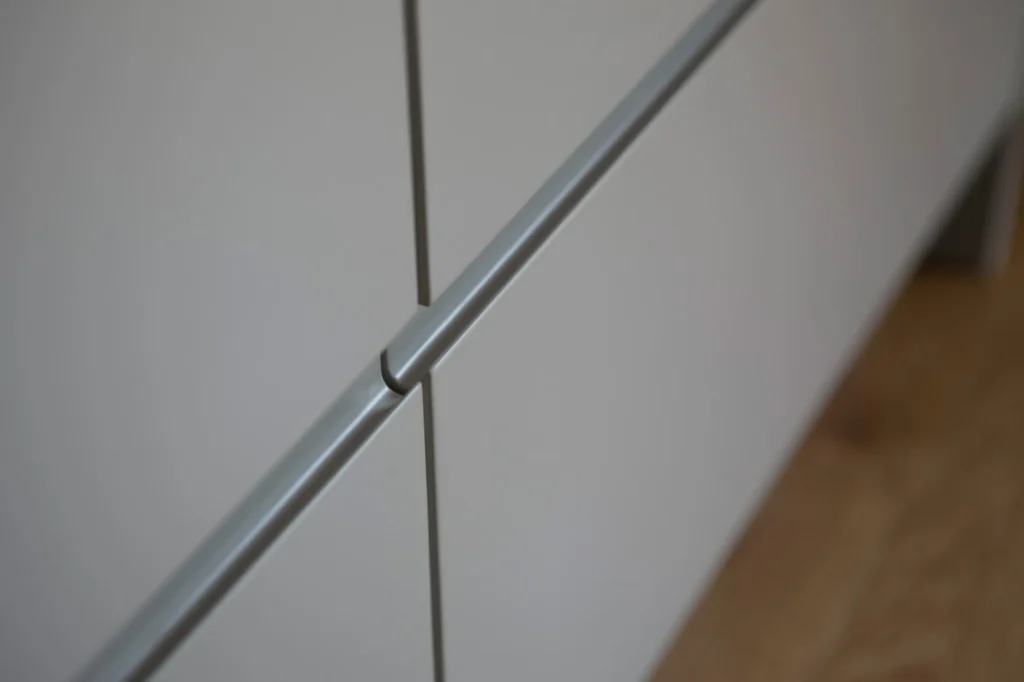
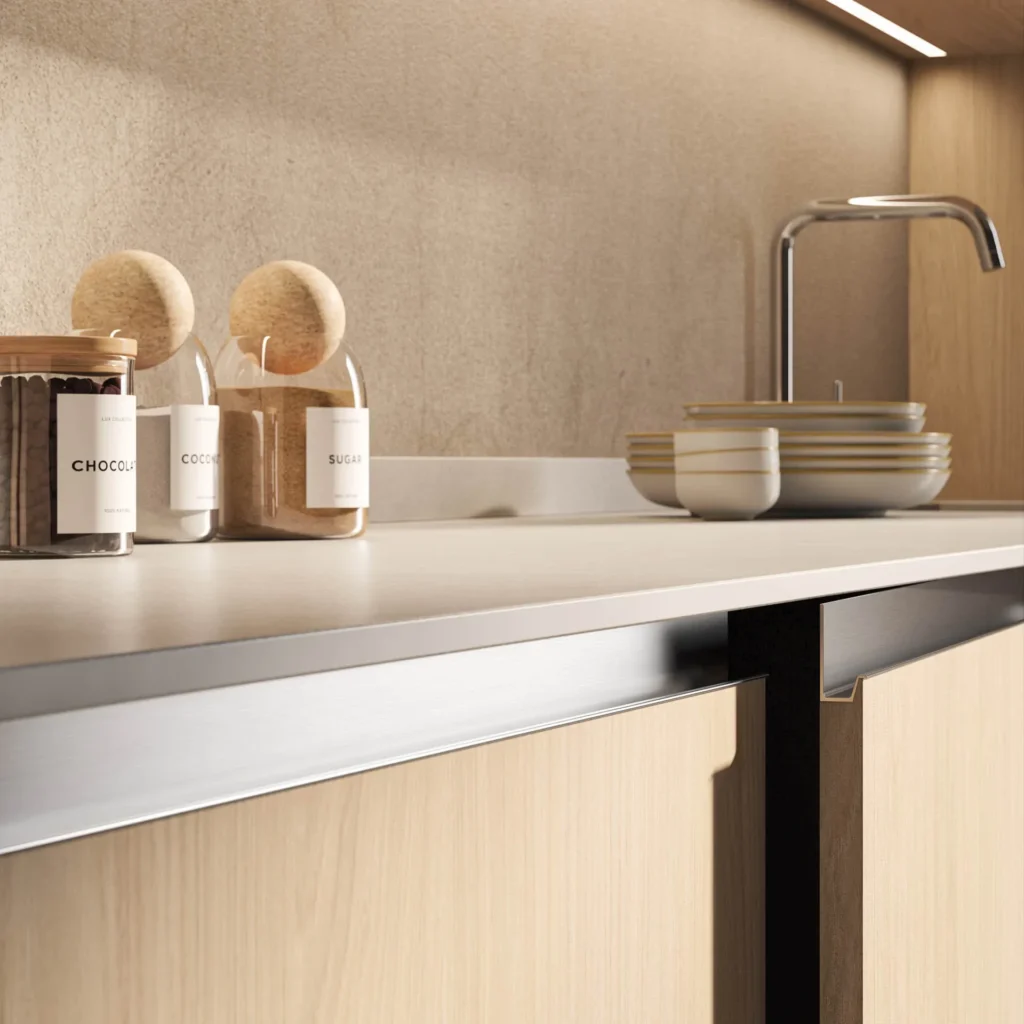
Handleless cabinets achieve a minimal look by replacing traditional hardware with engineered openings. These methods include J-pull profiles cut directly into the door, aluminum profiles installed behind the door edge, or mechanical push latches. Each method affects how your hands interact with the door, how the door moves, and how durable the system feels. A handleless kitchen relies heavily on ergonomics, geometry, and mechanism quality. These elements must balance comfort and long-term use.
Types of handleless operation
Handleless cabinets often use mechanisms that rely on spring-loaded latches or drawer runners. Push-to-open systems work through light pressure and use magnetic or spring-based latches to release the door. J-pull designs depend on a carved channel with a 30–45 degree angle, providing enough grip for the fingers. True handleless systems use an aluminum profile fixed between cabinet units, forming a gap for your hand.
Here is a quick comparison:
| System | How It Works | Key Feature | Notes |
| Push-to-open | A push latch opens door | No profile line | Needs soft-close runners |
| J-pull | Carved J groove on door | Integrated grip | Works best with 18–22mm doors |
| Gola profile | Aluminum rail behind door | True handleless | Clean horizontal lines |
Technical detail
Push-to-open systems require soft-close runners with built-in dampers. The latch mechanism usually uses a spring and magnet combination. A typical force of 4–6 kgf triggers the release. This ensures safety and avoids sudden openings.
Entity references
This topic involves mechanism, door profile, drawer runner, surface treatment, and aluminum profile. These entities help Google understand the technical scope.Handleless cabinets often relate to the concept of ergonomics, which explores how people interact with objects. Here is what most homeowners do not know: the system you choose will affect installation depth, door height, countertop overhang, and cleaning frequency.How does this matter for real kitchens? You will discover the impact when comparing systems in the next section.
What makes handleless cabinets ideal for minimal home design?
Handleless cabinets are ideal for minimal homes because they remove visual clutter and blend into the room. Their flat surfaces and clean lines create a quiet, open feel. They pair well with neutral colors, matte finishes, and natural textures that define modern minimalist design.
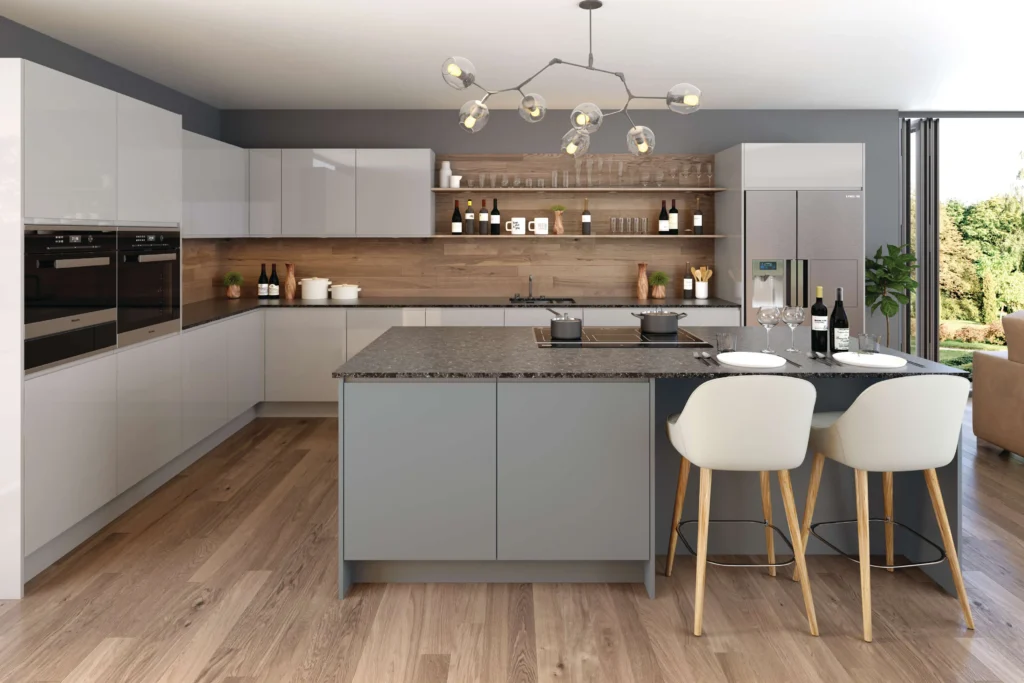
Minimalism depends on simplicity and order. Handleless cabinets support this idea by removing distractions. Without handles, the eye follows longer horizontal or vertical lines, creating a sense of calm. Many modern homes use smooth slab doors with continuous grain patterns. These match neutral palettes like white, grey, sand, oak, or walnut.
Why minimal homes prefer handleless cabinets
Minimal homes often follow principles like clean geometry, soft textures, simple transitions, and balanced light. Handleless doors help achieve all of these. They also work with modern features like:
- integrated lighting under wall cabinets
- continuous countertop edges
- aligned appliances
- hidden storage zones
Design entities and materials
Surface treatment such as matte lacquer, PET, acrylic, or wood veneer improves the seamless look. These materials also resist fingerprints, support UV stability, and offer easy cleaning.
You may also read about lacquer as a surface coating on Wikipedia:
Technical detail
Most handleless minimal kitchens use 18–25mm slab doors with soft-close hinges. The doors sit flush or near-flush with a 2mm gap. This gap is necessary for thermal expansion and ergonomic clearance.
Scenario examples
- Minimal apartments use white or grey slab fronts.
- Japandi homes pair wood veneer with flat handleless lines.
- Open-plan lofts use long horizontal Gola profiles to match architecture.
Here is what most homeowners do not know: the choice of finish strongly affects the final mood. Matte surfaces absorb light, while glossy surfaces reflect light and may change the feeling of the room.
Let’s look at how to choose the right mechanism next.
Which handleless opening systems should you choose for your kitchen?
Handleless systems include push-to-open latches, J-pull grooves, and aluminum Gola profiles. Each option suits different kitchens depending on use frequency, cleaning habits, and desired look. The right choice depends on comfort, durability, and installation style.
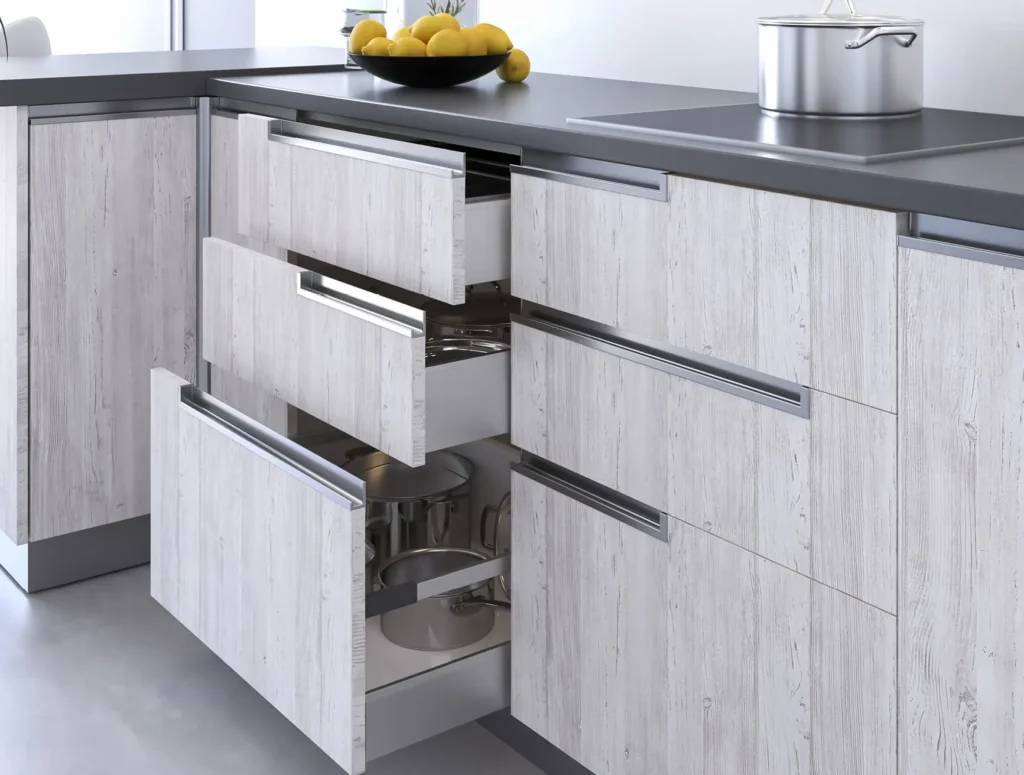
Choosing the right opening system depends on how you cook, how often you use drawers, and how important easy cleaning is to you. Some homes prefer a zero-profile look. Others want strong grip control. Each system changes the weight distribution on hinges and drawer runners.
System-by-system breakdown
1. Push-to-open
This uses a latch installed behind the door. You press to open and press again to close.
- Very clean look
- Works for upper cabinets and base units
- Requires soft-close runners
- Sensitive to dust around the latch
2. J-pull
This uses a carved J-shaped groove.
- Very ergonomic
- Easy to clean
- Works well with 18–22mm doors
- Creates a visible shadow line
3. Gola profile
Often called “true handleless.”
- Uses a metal profile
- Clean horizontal lines
- Works well with long drawers
- Requires planning for profile color
Table: Mechanism Comparison
| Feature | Push-to-open | J-pull | Gola |
| Cleanest look | ★★★★★ | ★★★★☆ | ★★★★★ |
| Durability | ★★★★☆ | ★★★★★ | ★★★★★ |
| Cleaning | ★★★★☆ | ★★★★☆ | ★★★☆☆ |
| Cost | Medium | Medium | High |
Technical detail
Gola profiles are usually made with aluminum that has been anodized for surface strength. Anodizing improves corrosion resistance.
Here is what many homeowners do not know: push-to-open systems can accidentally open with pressure from the inside if drawers are overloaded. J-pull grooves, on the other hand, must be cut at the correct angle or they will trap dirt.
We will compare them visually next.
How do handleless cabinets compare to traditional cabinets?
Handleless cabinets differ from traditional cabinets in appearance, ergonomics, safety, and ease of cleaning. Traditional cabinets rely on handles, while handleless designs depend on integrated profiles or mechanisms. This affects long-term comfort, layout flow, and visual style.
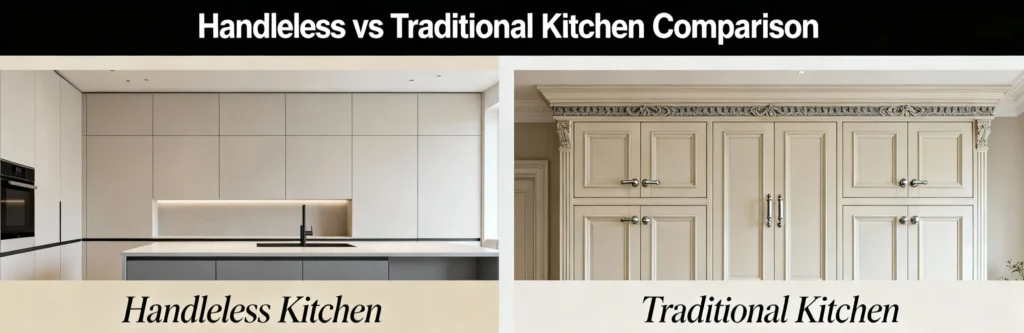
Most homeowners compare handleless and traditional cabinets when planning a renovation. The key difference is the presence of hardware. Handles add character in classic homes but interrupt clean lines in modern homes. Handleless kitchens often match slab doors, while traditional kitchens use framed or shaker designs.
Comparison overview
| Aspect | Handleless | Traditional |
| Look | Clean, minimal | Decorative, detailed |
| Cleaning | Easy | May trap dirt around handles |
| Safety | No sharp handles | Handles can catch clothes |
| Grip | Groove or push | Full grip handle |
| Cost | Medium-high | Low-medium |
Technical detail
Handleless systems require full overlay doors for the best effect. Traditional kitchens use partial overlay or inset doors. The installation method changes the cabinet’s visual depth and shadow line.
Ergonomic insight
Handleless kitchens rely on finger space or light pressure movement. They need good soft-close runners and strong hinge support. Traditional kitchens rely on pulling force through a handle, which reduces strain.
Here is what most homeowners do not know: handleless kitchens require proper lighting. Without handles, shadows become part of the design. This adds depth and visual rhythm.
Let’s move to materials next.
What materials and finishes work best for handleless kitchens?
Handleless kitchens work best with slab doors made from MDF, plywood, or particleboard with laminate, PET, acrylic, or lacquer finishes. These materials keep surfaces smooth and support clean, minimal lines without warping.
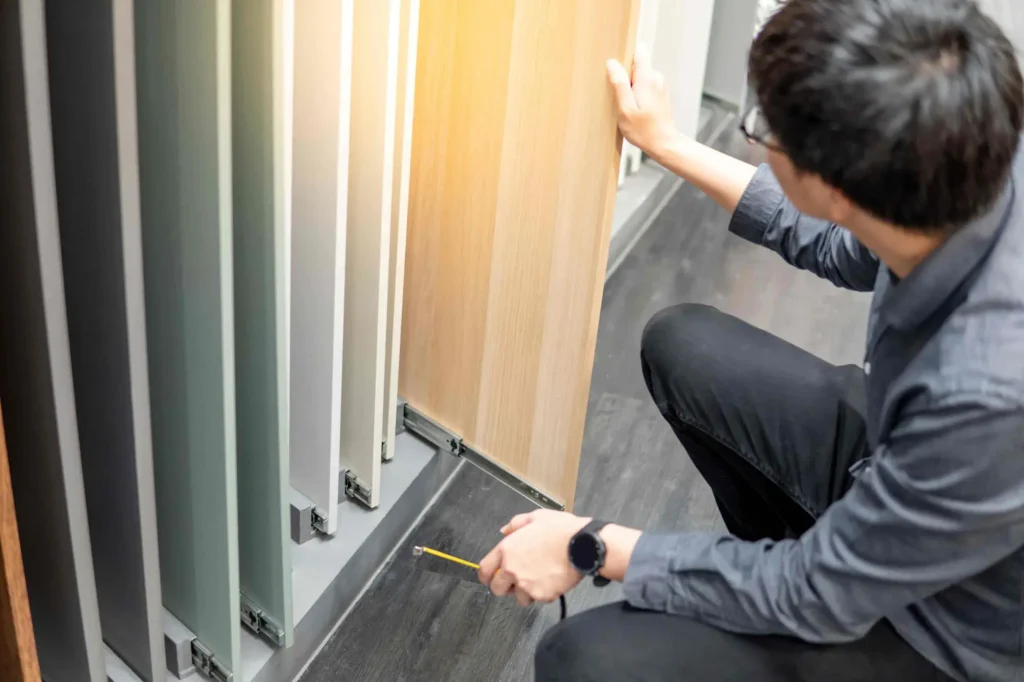
A handleless kitchen needs stable and flat surfaces. Slab doors must resist moisture, heat, bending, and daily use. They also need clean edges because any irregularity breaks the minimal look. MDF is common because it accepts paint and lacquer well. Laminate and PET finishes offer durability and cost savings.
Material breakdown
MDF
- Smooth surface
- Good for lacquer
- Stable thickness
Plywood
- Strong core structure
- Works for veneer finishes
- Higher cost
Laminate
- Scratch-resistant
- Cost-effective
- Many color options
Acrylic / PET
- Glossy or matte
- Fingerprint resistant
- UV stable
Technical detail
A common slab door thickness is 18–22mm. Thicker doors (25mm) create a luxury look but need stronger hinges. Veneer must be applied with continuous grain to maintain visual flow.
Cleaning note
Smooth surfaces reduce dirt accumulation, especially around opening systems. Some finishes like matte PET hide fingerprints better.
Here is something many people do not know: surface finish affects how light interacts with the kitchen. Glossy surfaces reflect light and can make small spaces brighter. Matte surfaces soften the environment.
Next, let’s explore how handleless kitchens work in different room sizes.
How can handleless cabinets improve small or open-plan spaces?
Handleless cabinets improve small and open-plan spaces by reducing visual clutter and creating longer lines. The design helps rooms feel wider and more open. It also supports flexible movement, especially in tight kitchens or shared living areas.
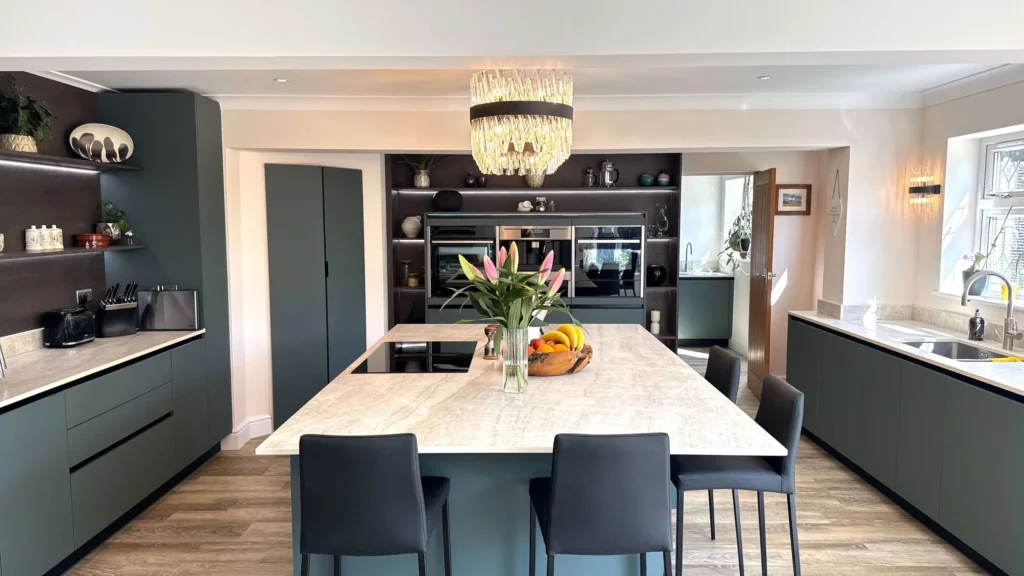
Small kitchens benefit from every inch. Handles often cause visual breaks. Removing them creates a smoother look. When the eye meets fewer interruptions, the room feels larger. Handleless kitchens also support continuous countertops, which connect cooking areas with dining or living zones.
Space benefits
| Space Type | Handleless Effect |
| Small kitchen | Feels larger, fewer breaks |
| Narrow layout | Easier movement |
| Open-plan home | Smooth transitions |
| Studio | Invisible boundaries |
Technical detail
Gola systems add 20–30mm extra gap. This gap becomes a shadow line that visually stretches the room. Push-to-open systems keep surfaces fully flat, ideal for ultra-small kitchens.
Lighting impact
Linear LED lights installed above or below cabinets enhance the seamless look. When combined with matte surfaces, the result is soft and warm.
Here is what most homeowners do not know: handleless cabinets also reduce “collision points.” Without handles, you will not bump into metal edges while moving around small spaces.
Next, let’s talk about practical problems and solutions.
What common problems do handleless kitchens face and how to solve them?
Common problems include fingerprints on matte finishes, dust buildup in grip channels, push latch misalignment, and limited grip for wet hands. These issues can be solved with proper materials, careful installation, and simple maintenance routines.
Every kitchen design comes with small challenges. Handleless kitchens are no different. Many issues come from material choice or installation method. Some problems appear after long-term use, especially in high-traffic homes.
Problem + Solution overview
| Problem | Cause | Solution |
| Fingerprints | Matte finish | Choose PET matte or veneer |
| Dust in groove | J-pull shape | Regular wipe with soft brush |
| Weak push latch | Misalignment | Adjust hinge or replace latch |
| Hard to open | Wet hands | Use Gola for base cabinets |
Technical detail
Push-to-open latches need precise alignment within ±1.5mm tolerance. If the door moves outside this range, the latch may fail to release. J-pull grooves should have a 30–45° cut angle for ergonomic grip.
Extra tips
- Use soft-close runners with load rating above 30–40kg.
- Use anodized aluminum Gola for durability.
- Seal veneer edges to avoid moisture.
Here is what you may not know: many push-to-open problems come from drawer overload, not the mechanism itself.
Now we move to maintenance.
How should you clean and maintain handleless cabinet surfaces?
Handleless cabinets are easy to clean with mild soap, microfiber cloths, and weekly wiping of grip channels. Different finishes need different care routines. Matte PET and laminate require less cleaning, while lacquer and acrylic need softer cloths.
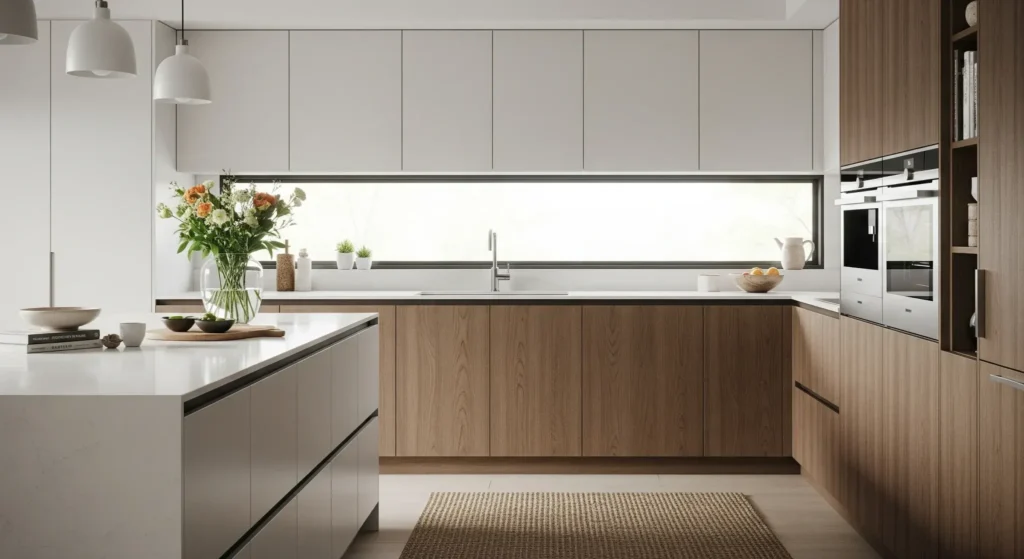
A good maintenance routine keeps your kitchen looking new. The absence of handles removes one cleaning point, but grip channels and push latches still need care.
Material-specific cleaning
| Material | Cleaning Method |
| Laminate | Mild soap + soft cloth |
| PET / Acrylic | Microfiber cloth + water |
| Lacquer | Gentle wipe, avoid chemicals |
| Veneer | Dry cloth + light oil treatment |
Technical detail
Grip channels should be brushed with a narrow cleaning tool once a week. Push latches should be checked every 6–12 months. A typical latch lasts 50,000 cycles, enough for many years.
Prevention tips
- Avoid abrasive sponges
- Keep moisture away from raw edges
- Use LED lighting to reduce heat exposure
Here is what most homeowners do not know: matte PET handles fingerprints better than any lacquer finish.
Conclusion
Handleless kitchen cabinets bring a clean and modern look to any home. Their smooth surfaces, smart mechanisms, and minimal lines make spaces feel calm and open. With the right materials and systems, they stay practical and stylish for many years.
Share Your Plan, Get Ideas
If you are planning a kitchen upgrade or a full-house interior project, you can share your layout with us. We can provide ideas, material suggestions, or a fast quotation based on your space. Handleless kitchens look simple, but choosing the right system can change how your home feels.