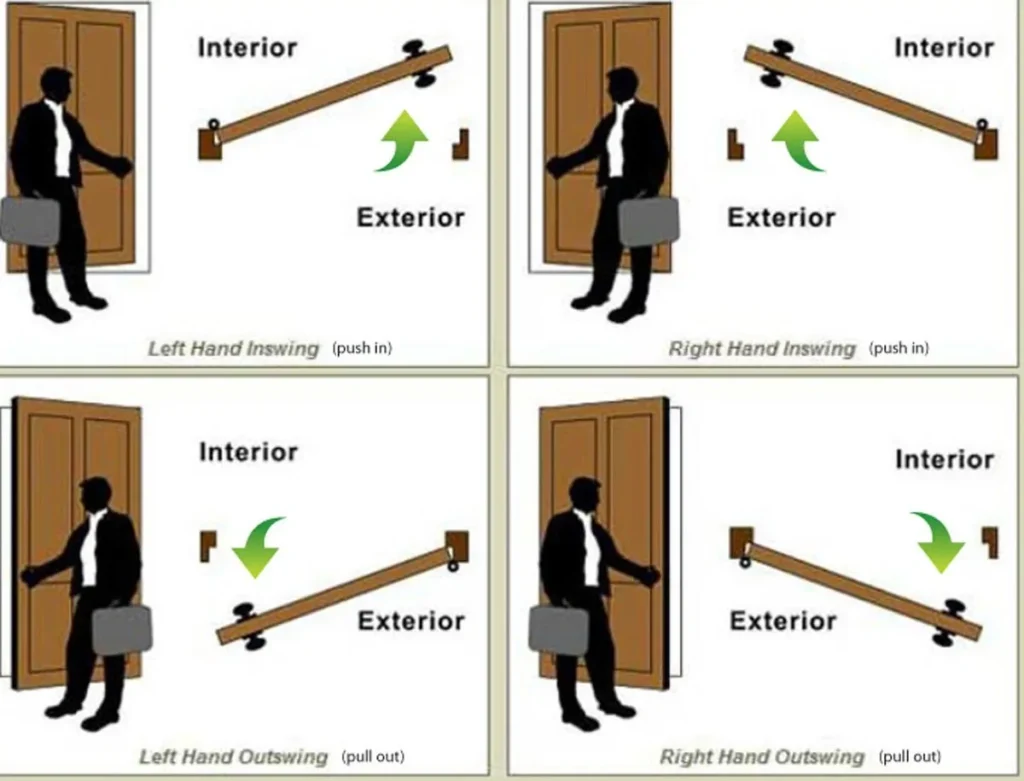
Crowded halls, clashing doors, jammed furniture—wrong swing wastes time and space. Use one outside rule and one hinge check. You will name the swing in seconds.
We are a one-stop building-materials partner based in Foshan, serving overseas projects. We cover kitchens, wardrobes, bathrooms, windows and doors, tiles, lighting, flooring, and wall panels. We work with homeowners, renovation teams, designers, developers, and builders. We also support interior and facade 3D design, whole-home style matching, export logistics, and after-sales services. The goal here is clear steps you can use on site.If you’re looking for a swing door solution for your project, visit our swing door page for answers. Contacting us can expedite your project.
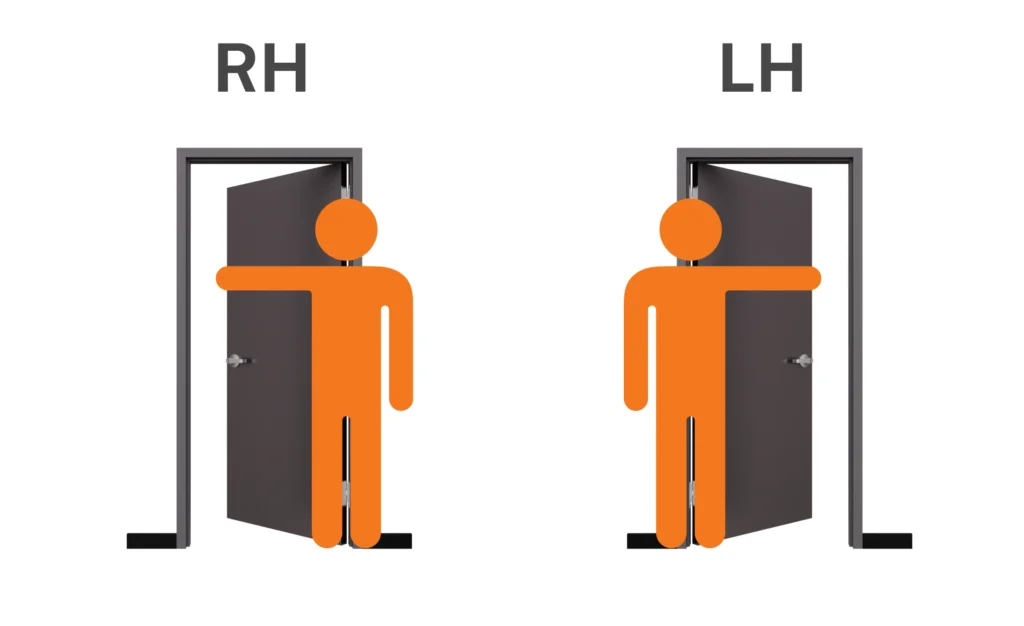
Here’s the fast path: stand on the outside of the door. Note whether it pulls toward you (inswing) or pushes away (outswing). Look at the hinge side—left hinge is left-hand, right hinge is right-hand. Combine both to name it.
You will see simple rules, pictures to search, and short tables. Read one section, test one door, and you’ll label any opening like a pro.
Stand on the Outside: The One Rule for Handing
Too many rules cause doubt. Use one. Always judge from the outside side of the door leaf.
The outside rule anchors every situation. Exterior doors: outside is outdoors. Bedroom: outside is hallway. Closet: outside is room side. Start there, then add swing and hinge. For background on hinge mechanics, see hinge.
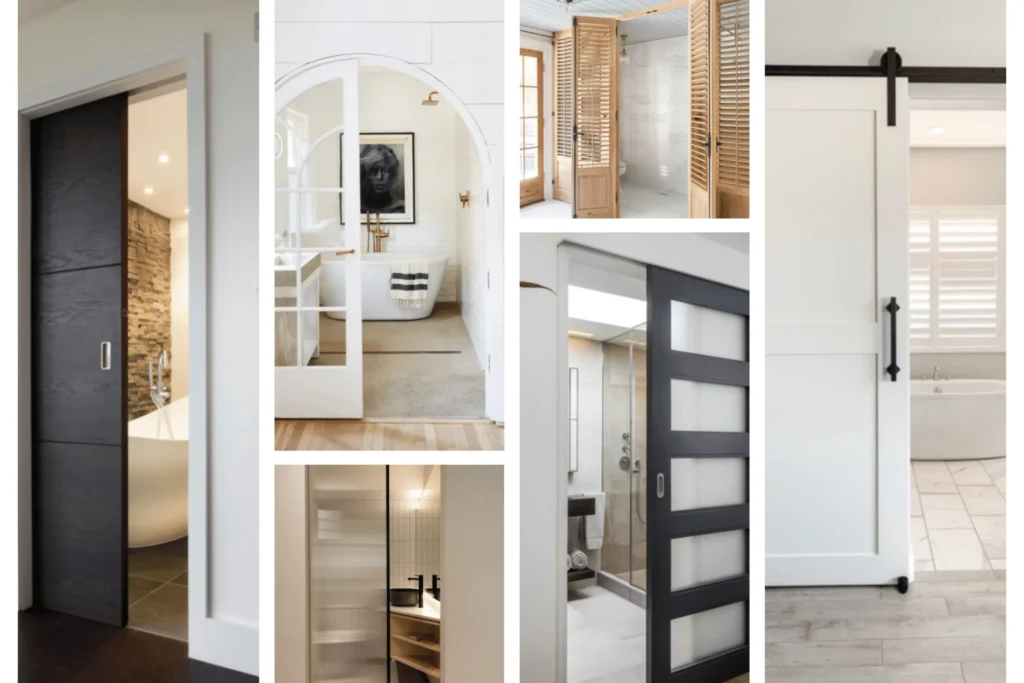
In practice, confusion starts with “which side is outside for interior rooms?” Think “public to private.” Hallway is outside to bedroom; corridor is outside to bathroom; living room is outside to a closet. For a pantry opening off a kitchen, kitchen side is outside. For mechanical rooms, the corridor/routine access side is outside. For exterior entries, outdoors is outside. When a door sits between two similar spaces—say two rooms—pick the side from which people most often approach. If you manage commercial space, outside is usually the corridor side. Mark your plan sheets with small arrows labeled “OUT” before you survey doors; it speeds field checks. If a frame has a threshold only on one face, that face is usually the outside. If hardware has a keyed cylinder on one face and a turn on the other, the keyed face is often the outside. These signals keep your first step stable and remove 90% of guesswork.
Outside cues you can trust
| Cue | Means “outside” when… |
| Keyed cylinder face | You stand on keyed side (most entries) |
| Corridor vs room | Corridor is outside; room is inside |
| Hall vs closet | Room side is outside; closet is inside |
| Exterior threshold | Threshold face toward you = outside |
Read the Hinges: Left vs Right Made Obvious
Left and right should take one glance. Face the outside. If hinges sit on your left, it’s left-hand. On your right, it’s right-hand.
Add swing to finish. You already know outside. Check if leaf pulls toward you (inswing) or pushes away (outswing). Say it out loud: “Left-hand inswing” or “Right-hand outswing.” Done.
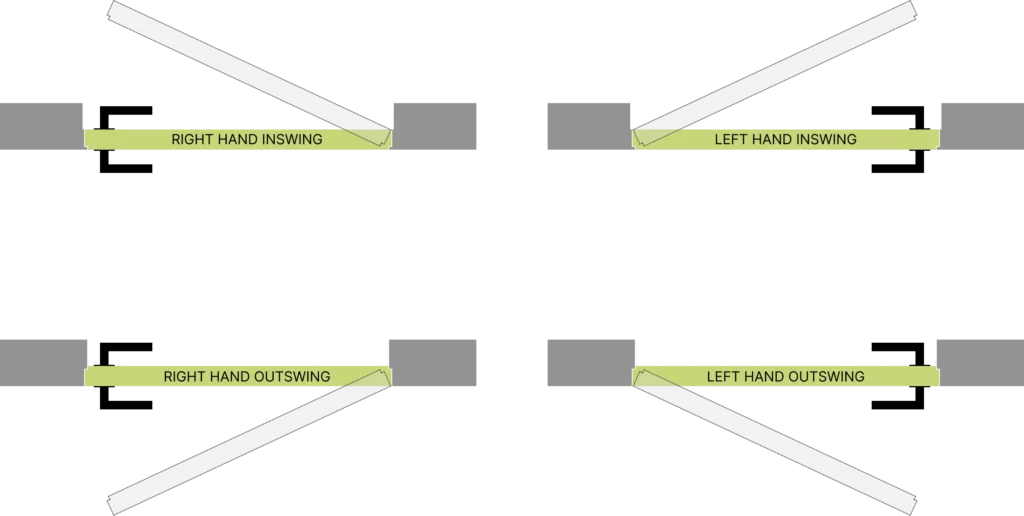
This naming system stays stable across interior and exterior doors and works for single or pair doors. The trick is to avoid flipping yourself around the frame. Do not step through and then retest; stay put. If you move, your left/right can invert. Field teams like a quick rhyme: “Hinges left, LH; hinges right, RH.” After that, decide if you pull (inswing) or push (outswing). In shops that use “reverse” terms, “right-hand reverse” equals “right-hand outswing.” If you inherit drawings with reverse notation, convert them before ordering to avoid mixed language on site. For French doors, decide handing per active leaf: the door with the latch is the one you name. In pairs without an astragal, name each leaf so hardware comes correct.
Handing mini-table
| You see from outside | Name |
| Hinges left + door pulls toward you | Left-hand inswing (LHI) |
| Hinges left + door pushes away | Left-hand outswing (LHO) |
| Hinges right + door pulls toward you | Right-hand inswing (RHI) |
| Hinges right + door pushes away | Right-hand outswing (RHO) |
Inswing or Outswing: Pick What Fits Space and Safety
Both work; context decides. Hall baths often inswing for privacy. Commercial exits commonly outswing for egress. Weather, security, and stairs also matter.
Stand outside. If the leaf comes toward you, it’s inswing. If it goes away, it’s outswing. Check walls, stairs, and furniture. Pick the path that keeps traffic clean and safe. See building code for why public egress doors often swing out.
Inswing protects hinges from tampering and keeps weather strips pressed by indoor pressure, but it can hit fixtures. Outswing clears interiors, helps emergency flow, and sheds wind better, yet needs secure hinges and clear exterior landings. At stairs, avoid a leaf that opens over a drop. At tight halls, avoid leaves that block circulation. For wet climates, outswing can seal better at the sill; use security hinges or non-removable pins to offset exposure. In multifamily or public buildings, life-safety rules often require outswing at rated exits for faster crowd movement (see egress). In small homes, bathrooms and bedrooms often favor inswing for privacy and noise control. If you must change swing in an existing frame, confirm latch backset, strike location, and hinge prep align; some frames are not reversible without new mortises. Choose the option that removes conflict first; finishes and trim follow function.
Quick chooser
| Condition | Better swing |
| Narrow hall, heavy foot traffic | Outswing (keeps hall clear) |
| Small bathroom with fixtures behind door | Outswing or pocket solution |
| Wind-driven rain at entry | Outswing with proper sill/hinges |
| Security concern on exterior | Inswing or outswing with security hinge |
Interior vs Exterior Doors: Details That Change the Call
Interior doors follow flow and furniture. Exterior doors add weather, threshold, and security to the mix—small details, big impact.
Start with outside rule. Then ask: is this door part of a path that people use to exit? Is weather a factor? Does hardware need a keyed face or better seal? Answers nudge swing choice.

Interior leaves usually sit over finished floors with no threshold. Furniture sets the stop position. For bedroom doors, check bed position and light switch reach; most people open against the wall to free space. For bathrooms, avoid the leaf colliding with a vanity drawer or a toilet. If space is too tight, consider a pocket or barn-style slide. Exterior leaves bring more layers: threshold height, sweep seal, weatherstrip contact, and hinge security. Outswing thresholds often seal well against wind but require a safe landing. Inswing entries hide hinge pins and give a sheltered pull when you walk in with groceries. If your porch is tiny, an inswing can prevent the door from sweeping guests off the step. On coastal jobs, corrosion rating for hinges and latches matters as much as swing. In snow regions, outswing can reduce snow push-in, yet drifts can block opening—consider storm doors and porch design. Each site tells you which risk to lower first.
Interior vs exterior at a glance
| Aspect | Interior | Exterior |
| Threshold | Usually none | Weather threshold/sill |
| Security | Privacy focus | Hinge security, cylinders |
| Weather | Minimal | Wind, rain, sun |
| Egress rules | Light | Often stricter |
Hardware and Handle Placement: Make Handing Match
Right door, wrong hardware wastes days. Order levers, latches, and closers to match handing and swing. Many levers reverse; some do not.
Before you buy, confirm latch backset, strike height, and hinge size. Name the door clearly: “RHI 36×80, three 4-in hinges, 2-3/8 in backset.” Your supplier will thank you.
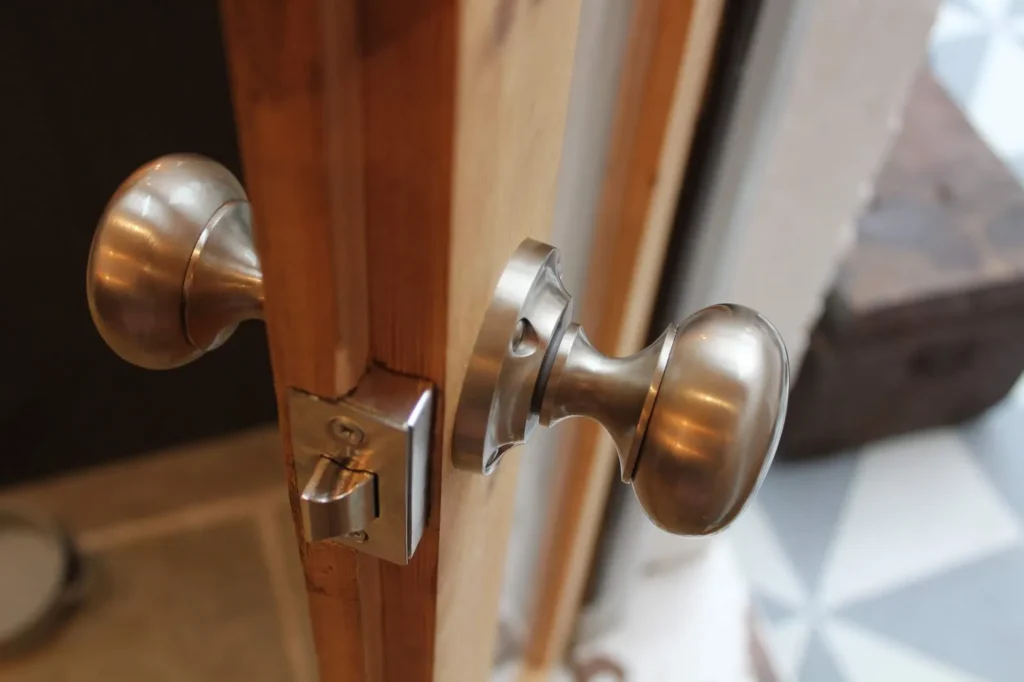
Locksets come in right-hand and left-hand variants. Many modern levers are “handing reversible,” but mortise locks and panic devices often are not. Hinges vary by size and corner radius; match the frame mortises to avoid gaps. For heavy or tall doors, add three hinges minimum and size them to carry the load. Door closers also have handed bodies or arms; check the spec sheet. When replacing only the slab, verify hinge locations and backset match the old frame. If you are swapping swing from inswing to outswing, the strike and weathering change; order a correct threshold and sweep. For exterior outswing, specify non-removable hinge pins or set screws. For interior privacy locks, choose a turn style that matches local norms so guests know how to unlock. Basic terms like latch, strike, and lever are part of the broader door hardware set (see door for parts overview).
Hardware checklist
| Item | What to match | Tip |
| Lever/lock | Handing, backset | Confirm reversible or fixed |
| Hinge | Size, corner radius, material | Use security pins outdoors |
| Closer | Handed vs non-handed | Confirm swing and frame type |
| Strike | Height, lip length | Deep casings need longer lips |
Double, French, and Special Doors: Name the Active Leaf
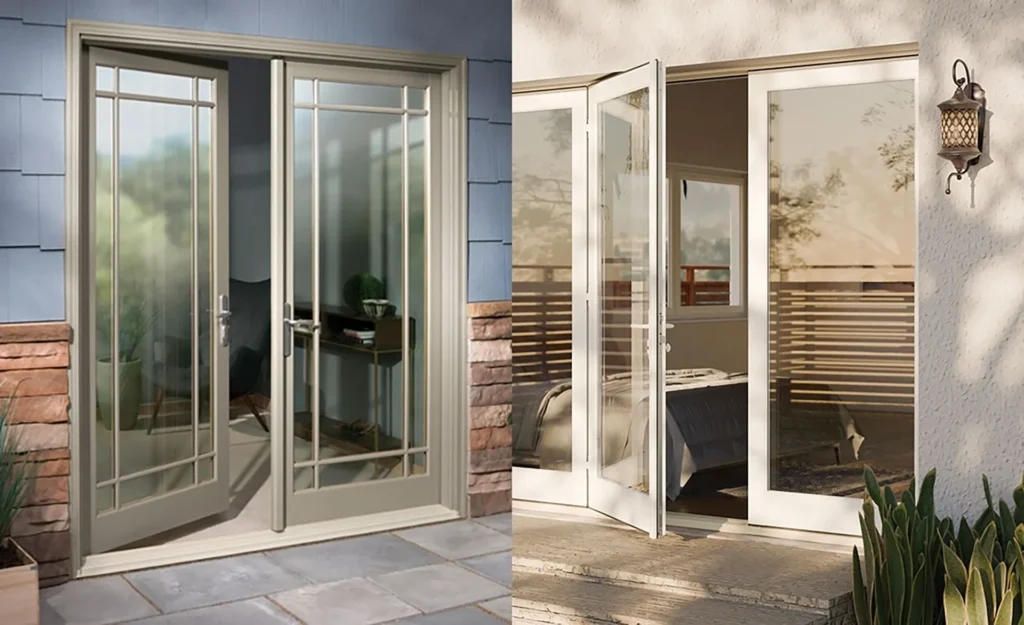
Pairs need one extra word: the active leaf. Name handing and swing by the active side. The other leaf can be fixed or semi-active with surface bolts.
Stand outside. Find the leaf with the latch. Name that leaf with the same left/right + in/out method. Then specify the passive leaf and bolt type.

French doors have two leaves that meet in the middle. The leaf you pull or push first is active; the other has surface or flush bolts top and bottom. When ordering, call out “active right” or “active left” along with the swing. For pairs in corridors, confirm both leaves do not crash into nearby doors. For double-acting kitchen doors (café or saloon style) that swing both ways, standard handing terms do not apply; you specify double-acting hardware. Sliding systems—pocket or barn style—sidestep hinged handing entirely but demand wall space. If a pair must meet fire or smoke rating, check labeling, closer types, coordinator bars, and latch-bolt projections so both leaves lock as required. On entries with an astragal (center strip), note whether it sits on the active or passive leaf; wrong choice can block weather seals or panic devices.
Pair door call-outs
| Feature | Option |
| Active leaf | Left or Right |
| Passive leaf | Surface or flush bolts |
| Astragal | On active or passive |
| Rating | None / Smoke / Fire |
Clearances and Conflict Checks: Walls, Stairs, and Appliances
A correct name is not enough. The door must open fully without hitting walls, stairs, or machines. Walk the arc before you commit.
From the outside, swing the imagined leaf. Check for light switches, radiators, cabinets, and appliance doors. Mark a safe arc on the floor with tape before drilling hinges.
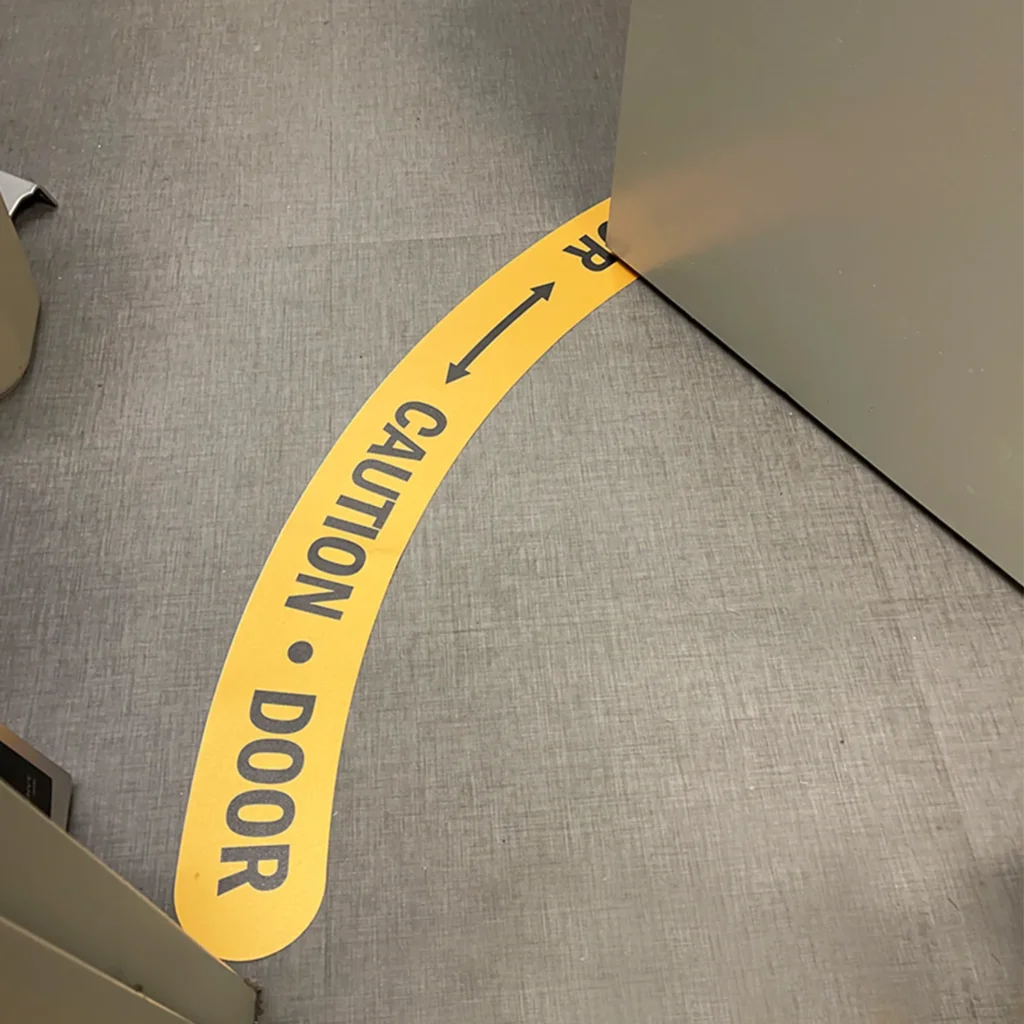
Small rooms make great traps. Bathroom doors often collide with vanity drawers; choose outswing or pocket. Hall doors can crash into each other in pinwheel corners; adjust one to the opposite hand. At stairs, doors cannot swing out over a nosing where someone could fall back. In laundry rooms, check the washer and dryer door swing; keep handles from clashing with the leaf. For kitchens, confirm refrigerator and oven doors do not hit the door leaf or jam. In bedrooms, avoid a leaf that blocks a wardrobe or shuts behind furniture feet. On commercial corridors, coordinate with ADA/accessible clearances at pulls and latches; even at home, a 32-in clear opening is a good aim. Draw quick arcs with masking tape at 30°, 60°, and 90° so you and your installer see conflicts fast. A minute with tape saves hours of patching holes later.
Quick clearance table
| Item | Good target |
| Opening width (bed/bath) | ~32 in clear |
| Door return wall (latch side) | ≥ 4–6 in for hands |
| Leaf sweep near stair | No swing over top step |
| Appliance conflict | Open both without collision |
Quick Tests and Troubleshooting: When You’re Still Unsure
Sometimes labels, frames, or old hardware make things murky. Use two fast tests and one sketch to remove doubt on site.
Stand on the outside and do the single-hand test. Then draw a two-line sketch for records. If legacy terms like “RHR” appear, translate them to your chosen system.
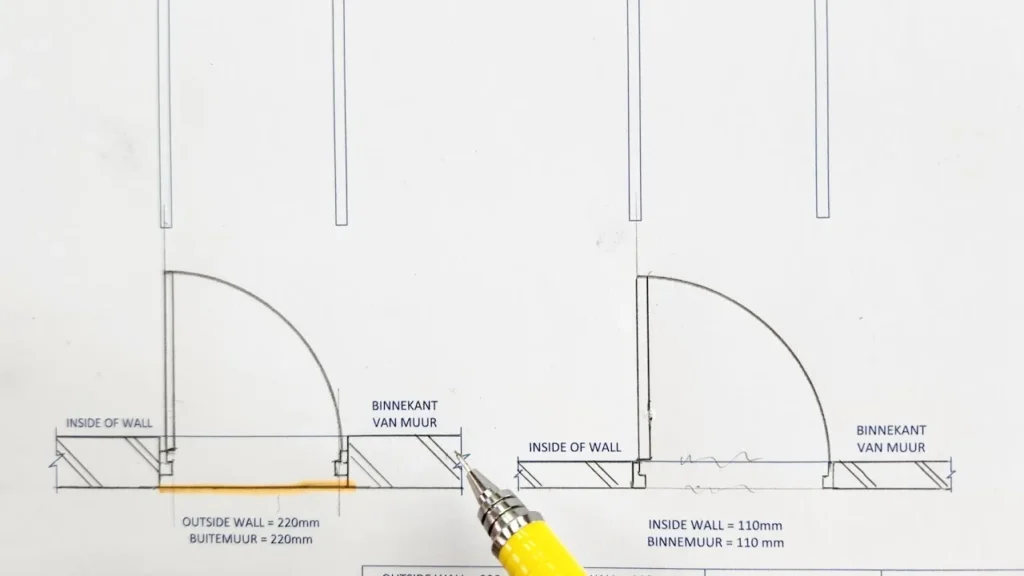
Single-hand test: from the outside, place your back to the hinges and your hand on the latch side. If your left hand reaches the latch, it’s LH; if your right hand reaches it, it’s RH. Then decide inswing or outswing. Sketch method: draw a line for the wall and a short line for the door. Add a small arc to show swing. Write “OUT” on the outside and label the hinges L or R. Snap a photo with your phone. For old “reverse” labels, remember: “RHR” = right-hand outswing; “LHR” = left-hand outswing. If a frame is prepped opposite to the slab you have, do not force it—return and reorder hardware or use a fresh prehung. If you must flip a light-duty interior door in place, fill the old hinge mortises, cut new ones, and move the strike, but note that paint and veneer repairs will show. Clarity on paper prevents all of that.
Translation table
| Legacy term | Plain language |
| RHR | Right-hand outswing |
| LHR | Left-hand outswing |
| RHI | Right-hand inswing |
| LHI | Left-hand inswing |
Ordering and Documentation: Say It So Suppliers Get It Right
Good notes avoid wrong hardware and re-drills. Put handing, swing, size, and hinge count in one line. Add drawings for pairs and special frames.
Write it once, paste it into orders, and store it in your job file. Use the same terms across teams so install day goes fast.

A solid order line looks like this: “RHI 36×80, 1-¾ in thick, three 4-in hinges, 2-3/8 in backset, brushed finish.” For exterior entries, add threshold type and security hinges. For pairs: “Active RHO, passive with surface bolts, astragal on passive.” Attach a small plan with the OUT arrow. If the supplier uses “reverse” labels, include your translation table or ask them to convert. Keep a door and hardware schedule for larger jobs; even for small projects, a shared spreadsheet stops late-night texts about which leaf does what. Before install day, print labels and stick them to frames. The crew will match doors to frames without opening every box. After install, keep your sketches and photos; they help future service calls and remodels. Clear words keep money in the budget where you can see it.
One-line spec template
| Field | Example |
| Hand + swing | RHI |
| Size | 36×80 in |
| Thickness | 1-¾ in |
| Hinges | (3) 4-in |
| Backset | 2-3/8 in |
| Notes | Ext: threshold + security pins |
Conclusion
Stand on the outside, read the hinges, and name the swing. Check space and safety, then order hardware to match. Clear steps, clear drawings, zero confusion.
Share Your Plan, Get Ideas
Send a quick sketch and a few photos. We can mark the outside side, confirm handing, and suggest the best swing for your layout and codes. 想开始了吗?把户型图发给我们就行。